Author: Janie Braverman

  • Lists

    Cat. 
    Donkey.
    Cigarettes and dust.
    Smoke from the trash heap.
    Allergens.  Triggers.  Potential poison.

    Dolphin.
    Beach.
    Hammock.
    Not quite cold enough Corona.
    The light in your eye.
    Comforts.  Pleasures.  Aphrodisiacs.

    The sweet grace
    of the back of your hand
    on my cheek.
    Warm calves accepting
    of my cold feet.
    A shared bowl of yogurt and nuts,
    frittata on your plate and then in my belly.
    Home.

    Two years ago she started to tell me
    the story of the day she didn’t
    drown her children in the bathtub, didn’t
    starve them in the closet, didn’t
    beat them until they couldn’t scream any more, didn’t
    burn them with cigarettes, or the iron, or stove,
    scald them with water or freeze them
    with scorn.
    Two years since she didn’t
    leave them on their own to die
    on the top floor of the old house
    converted to apartments
    dried by the western plains wind into
    kindling, tinder, fuel.
    Two years and counting . . .

    Salt licks at my feet and I
    remember the smell
    of the sea, blown across the tidal pool.
    And sweat.
    Airplane sweat – tired, confined, medicinal,
    metallic.
    Just arrived in the tropics sweat – too heavy
    clothes, socks, long sleeve shirt thick with the
    smell of city and work.
    Sun sweat – open to the air, coconut
    with the scent of summers past
    lingering youth
    new beginnings.
    And the sweat of lust, salt rising
    sweet from your skin or
    is it mine.
    I sweat back the sweet salt of the sea –
    as you, too, lick your way up my feet.

    A crushed Coke can.
    Beach glass.
    High tide mark of broken shells.
    A streamer of plastic bread wrapper.
    Bottle tops.
    Sand.  Endless sand.

  • At The Office Of My Son’s Psychiatrist

    it begins with family history
    a gentle inquiry into the lives
    of my parents grandparents brothers and sister
    my ex-husband has come and gone already
    telling the story of his side

    any thyroid disease drug abuse alcoholism
    suicide successful or failed

    I wonder which is which

    eating disorders depression trouble with anger
    unstable moods

    I shake out the genetic map like a long unused tablecloth
    spilling deserted desiccated crumbs
    I share them with this young man, this bearded stranger
    I tell my father’s rage
    my mother’s silence
    my own profound depression beginning at thirteen
    a history of migraines ·
    suicide contemplated but never completed
    the most recent episode still raw like a rusty hacksaw blade
    chosen bits of the stories of my life

    you were a moody child?
    Sarah Bernhardt my mother called me
    with a penchant for high drama at dinner
    loud tears and slammed doors

    genetic history is a useful predictor of risk factors
    he smiles and says
    I think you are
    bipolar

    the word thumps to the carpet between us
    rolls gently in my mouth a metallic musical word a poet’s word
    bipolar
    he is naming me this pretty word
    his fingers steepled below his chin
    I think you should be evaluated
    he is naming but not knowing me

    you have a classic history all the indicators
    he leans back
    I think but do not say
    of course I am depressed because
    I know this analytical young man
    with his well polished loafers
    my son’s-not my-psychiatrist
    he’s thinking drugs to stabilize my mood, my life
    to close off the San Andreas fault of feelings
    to level like a condemned building a thing of no use
    he means to help with this lie of better
    better living through chemistry
    better not the lows so deep and dark
    better not the highs so bright so frightening to those
    who don’t know them who won’t or can’t embrace them
    better to be calm and dull and stupid
    he means well but his means would kill me

    let me ask you
    I listen carefully balance my need to be safe
    against my son’s need for me to be known
    genetic history may be a useful predictor of risk factors
    I listen carefully and I do not lie

    do your eyes ever play tricks on you
    I ask what does he mean
    do you ever see things that aren’t there
    as I think how to answer this, he goes on
    things out of the corner of your eye and you turn
    and nothing is there

    I resist the temptation to say Are you nuts? for this is
    what he does think, that I am nuts
    of course I see things
    I see poetry everywhere-even here-in this office
    and the auras I see are where I see them
    no I say and this is true

    do you ever hear things – things that aren’t really there
    in a crowd do you ever think someone is calling you but they aren’t
    or you hear the phone or the doorbell when they don’t ring

    of course I hear Mommie in a crowd
    and think the voice is calling me
    that’s not what he means
    he means the voices
    I consider-for nearly a heartbeat-telling him
    about the characters
    who live and breathe and walk with me
    the ones who tell me their stories when I am quiet enough
    to hear them over the chaos of my exterior life
    I almost tell him of course I hear voices voices
    of people more real to me than him
    but he is asking am I delusional
    I answer the only way I can
    I hear only things that are real

    I am not your patient
    sensitive to the universe not moody
    awake not bipolar
    human not nuts
    but because I am first a mother
    because telling these truths will not be useful and
    to help this earnest young man in tweed help my son
    I quiet the voices

    for now
    I listen carefully and do not lie
    but neither do I tell

  • Bing

    I hear the grind of grasshoppers,
    rusty-hinge call of the redwing blackbird,
    my own breath, ragged and too quick.
    It’s been too long since I’ve taken this walk,
    forever since we took this walk together.

  • Blue October

    Bright blue winter glove on pavement.

    Smurf hand
    catching leaves as if snowflakes
    pitted asphalt ready for winter

  • How many is not supposed to be a trick question

    How many is not supposed to be a trick question

    Do you have brothers and sisters?

    At a dinner party, a wedding, the first day of camp, this could be an icebreaker. In grade school, it could be a prelude to drawing a family portrait. At an initial speech pathology evaluation following a serious brain injury, it’s supposed to be something else, a yes/no question, to elicit a yes/no response. An entry to analysis not only of the ability to speak, but of cognitive function as well.

    Do you have any brothers or sisters?

    My son doesn’t always answer. He is reserved in his willingness to communicate with people he doesn’t know. The damage to his short-term memory means it takes time and repetition for him to know someone. I categorize people for him: That is someone we don’t know. A constant refrain in hallways and elevators headed to therapy or on an outing to the grocery store, a basketball game, or a movie theater. Not someone we know. Not someone we know. When it’s someone new to his care team or his medical team it goes like this: This is [insert name]. [Name] is [insert relationship]. Repeat and repeat.

    My son has been asked the screening question about brothers and sisters many times.

    By the first speech pathologist, at the University of Iowa Hospitals and Clinics (UIHC), during his first hospitalization. A lovely white-haired woman with dangling earrings and the aura of an interesting past, who connected well with him. She was evaluating how much he could understand, how well he could express himself. He used his eyebrows, as he still does, but that was when he wasn’t speaking at all.

    By the speech pathologist at On With Life, the first of several rehab facilities, who fed him pancakes to evaluate his ability to swallow. Still not speaking.

    By the speech pathologist at the Center for Disabilities and Development at UIHC, where no, he did not want to shoot the little mermaid and her cartoon cronies, using lasers by moving his eyes while staring into a computer monitor. Evaluating him for a speech assistive device as he struggled to speak. He was, however, alert and aware enough to roll those eyes with an edge of snark, not wanting to be treated as a child.

    I sat there thinking, Die, little mermaid, die already! I wonder, had I said that, if he would have been more willing to use his eyes as lasers, to blast her doe-eyed little icon off the computer grid. Maybe. Maybe not.

    He was asked by the speech pathology students at the speech clinic at UIHC: Do you have any brothers? Or sisters? What they lacked in experience, they made up for in enthusiasm, in being closer to his age (22 or so to his then 32⸻young adults who hadn’t forgotten how to play), and in their ability to learn from what doesn’t work, like the inevitable question that comes after he says yes:

    How many brothers do you have? or How many sisters do you have?

    How many is not supposed to be a trick question.

    The answer is supposed to be a number. The question is supposed to be about memory, word finding, aphasia screening, and other things speech pathologists assess. Sometimes my son closes his eyes. Sometimes he averts them. Sometimes he rolls them. But it’s a question he never answers.

    In speech therapy, it’s not useful for the family to answer for the patient. We make an exception for this line of questions.

    He has three sisters. Ask them. If you’re taking a medical history, he has two. If you’re asking about early childhood, he had two. Now he has three. He has brothers. If you’re asking about early childhood, he had one. He lost him for a while, but now mostly remembers that he got him back; if you’re taking a medical history, it’s his half-brother.

  • Impala

    Last fall, six weeks after President Nixon resigned, my father went out. He went out through the kitchen, into the garage, into the 1971 Chevy Impala, impeccably white, the dark green vinyl seats cool and smooth, heavy with the scent of cigarettes. I smoked in that car when I was thirteen, in the back seat with Kevin Harrison, smoked and necked and knew Daddy would never smell the difference. Would never know the scent of my cigarettes laid over his, my desires drowning his. Daddy loved that car. More than he ever loved me.

    I smoked in that car when I was fourteen, smoked and screwed and said screw you to Darren Fuller, who dumped me for Susie Fiedler, who already had everything. A big house, the best clothes. Her daddy loved her, why did she have to have my boyfriend, too, except just because she could. And I smoked and drank and screwed Kevin Harrison who would then dump me for someone, anyone else in the weeks after Daddy left. And sometimes I smoked and did my homework. I did my homework because I was always good at school and that gave me hope.

    Nixon had been a big disappointment to Daddy. Just like me. On that day, when Daddy went out through the kitchen, into the garage and into that goddamned white car, here’s what he might have done:

    He might have gone to the 7 Eleven, sat outside in that car, in the parking lot, his face lit by the neon 7 and the neon Eleven, awash in disappointment. He might have let the engine idle in park until he put it in
    gear, into reverse, backed out of the parking lot, not spraying gravel because it might fly up and chip the paint, and drove down the highway into the middle of the night.

    But he didn’t. We know he bought cigarettes, Lucky Strikes, we know that from the guy behind the register, Kevin Harrison’s stupid older brother, Scott. ”Yeah, Regina’s dad was in here-two nights ago-bought cigarettes and a six-pack of Coke.” Scott Harrison wasn’t cute like Kevin.

    And he wasn’t smart like Kevin. He always let his greasy hair hang over his
    forehead, as if that would hide the pimples.

    But I knew before we talked to Scott that Daddy had stopped for cigarettes and Coke. He always did.

    Here’s what else he might have done:

    He might have broken open the carton, fished out the first pack, stripped off the cellophane right there in the parking lot, in the front seat of that white car, smelled the fresh rush of new tobacco before the sulfur and smoke of the match. Daddy never used a lighter, not even the one in the Chevy, just matches. The glove box of the Impala was stuffed with books of matches from the places Daddy had been-the White Horse Bar, the Zanzibar, P.T.’s Topless Bar, the diners all along East Colfax and the truck stops between here and Reno, the far west end of Daddy’s territory. He had matches from just about everywhere in the known world. The lighter stashed in the crack between the deep green cushions in the front seat was mine, not his. He might have turned on the radio to listen to the news.

    Daddy might have inhaled that first full drag, shaken out the match and
    settled back into the dark green seat. He might have let his arm dangle out
    the window until he’d smoked that Lucky Strike down to the filter, then
    flicked it away in the dark and said, “Fuck it. I’m outta here.”

    He might have driven through the night, moving from one radio station to another, from one call-in talk show to another, far west into the mountains then down into the Utah desert. He might have driven as far as he could and then fallen asleep behind the wheel, nodding over the dotted white line into the semi rolling east towards Grand Junction. He might have crashed in a shower of glass, talill1g the Impala with him, but sparing the truck driver so he could go home to his wife and kids. He might have done that.

    Or maybe he got all the way to Salt Lake City, ringed by the same Rocky
    Mountains you can see from the hill at the top of our street. Maybe there he
    had another family. I read a story about that once, a cowboy with two wives, two families and two houses. The cowboy’s first wife didn’t know until he died, kicked in the head by a horse. Maybe Daddy had another family, one with a daughter who didn’t smoke and screw and get drunk on rum in the back seat of the Impala. Who didn’t hate the war. Maybe he liked her
    better because she was smarter and prettier and funnier and didn’t slam
    doors and cry in her room. Who didn’t think she was better than everybody
    else because she was smart. Maybe he liked her better because she didn’t
    know he was screwing slutty Lois Johnson across town and probably every
    other woman from here to Reno because my daddy was so good looking
    that all the ladies loved him.

    And maybe the woman in that house really didn’t know, instead of
    pretend-not-knowing, all the time with her pinched angry mouth, like
    somebody made her eat soap for telling the lie of it-ain’t-so, my husband’s
    not a drunk and a liar and a cheat. I never smoked or screwed in my mother’s car. That would have been too much for her to bear.

    Maybe on that clear crisp day in the fall, when the cottonwoods and elms
    had all turned to yellow, and the maples and Virginia creeper to orange and red, and the nights turned cold, maybe he bought those cigarettes and then went down to the EZ Pawn and bought a gun and bullets and then drove out somewhere and blew his stupid fucking brains out and a stray bullet bounced out of his skull and hit the gas line of the Impala and instant immolation. Maybe Daddy died in a funeral pyre like those Buddhist
    monks. Only not so pure.

    And here’s what else didn’t happen.

    I did not sneak out of the house after him, find him at the 7 Eleven, have a smoke with him in the front seat of that car. I didn’t hear the neat snick of my lighter, then see him smiling in the flare lighting his face, brighter than the dashboard lights, as we drove down the highway, smoking those Lucky Strikes. I did not drink rum and Coke in the back seat with my daddy, crunch the ice before it melted, while he cried and told me he loved
    me but he was leaving, then pass him the rum until he was too drunk to get out of the car to take a leak without falling down, much less drive me home. That’s how I learned to drive, when I was twelve. Driving Daddy home. Home from the White Horse Bar or the Black Horse Bar or from Lois
    Johnson’s stupid, run-down little house, with her grass all brown and dead,
    but mowed. I was twelve when I started mowing our grass, so my mother
    wouldn’t have to.

    I did not take the little Army surplus shovel from the trunk, folded up and tucked in by the spare, for digging out of the snow if he got stuck before he got the chains on. That Impala always did handle like a pig in the snow. I did not bash his head in as a single unlit cigarette dangled from his face as he tried not to piss on his feet.

    I did not use my lighter, the little silver one engraved To SK with Love, the one I swiped from some guy sitting at the counter at the White Spot on East Colfax that night we stayed out, Kevin Harrison and me, to see The
    Rocky Horror Picture Show
    at midnight and then didn’t go home until later, much later.

    And I did not comfort Daddy with shhhh… it’ll be all right, shhhh… don’t cry, while he whimpered it was cold, so cold and his white car lay in the bottom of a gully up above Morrison, south of the interstate. I did not say Daddy, I love you, I love you, I love you. And I didn’t hold him until the shaking stopped and his breathing stopped and the fire ate up his car, blistering the white into grey and then black, char where it used to be green, smoke all over now and not just on the seats, and he could never leave us again.

    And I don’t sit in the front seat of my mother’s car on Saturday mornings, looking out the window, hating him, while my mother cries and drives me across town to that house where I watch him mow the grass.

  • Thinking About Craft and Process

    CRAFT

    /kraft/

    • An activity involving skill in making things, often by hand
    • A skill used in deceiving others
    • Any vehicle designed for travel across or through water bodies, air &/or space
    • Tools used by poets & other writers

    Used in a paragraph

    What’s in your toolbox? Scene, sentence, scansion? Rhythm, repetition, & slant or straight rhyme? The line, the list, & the lament? Are you equally careful of white space, image, & text, of font, format, & form? Do you play with brackets, braces, ellipses, & semicolons?

    PROCESS

    /ˈpräˌses/

    • A series of steps or actions taken to achieve a particular end
    • A summons or writ requiring a person to appear in court
    • Verb: To perform a series of mechanical or chemical operations on something to change or preserve it

    Used in four paragraphs

    1. Where do you sit when you open your toolbox? Home or coffee shop? Do silence & solitude feed you or stifle you? Pen or laptop or desktop with dual monitors? Scrivener or Word? Are you a lark or an owl? Coffee or tea?
    2. Where do you start? Image or prompt or experience, or language itself? Does a character arrive, speaking in your head? Does a line arrive whole, waiting for what comes before & then after? Does the form announce itself or do you impose it yourself? What have I forgotten to mention? What has never occurred to me?
    3. Drafts: How do you distinguish one from the next? Is it enough to move (or remove) a comma? Eliminate an entire stanza or chapter or character? How do you organize your drafts—on paper &/or electronically? Have you ever lost one forever? Do you revise as you write? & if you do, how many drafts dance on the head of your pen?
    4. Interruptions: What causes them, how do you deal with them . . .

      ~ ~ ~

      ~ ~ ~

      ~ ~ ~

    . . . wait, where was I?

    Ah, yes. I remember.

    Are you a poet, a painter, a writer of prose? Yes is a complete & acceptable answer.

    When & what do you think about genre—or do you? Is that question about craft or about process? Here, too, you may want to say yes.

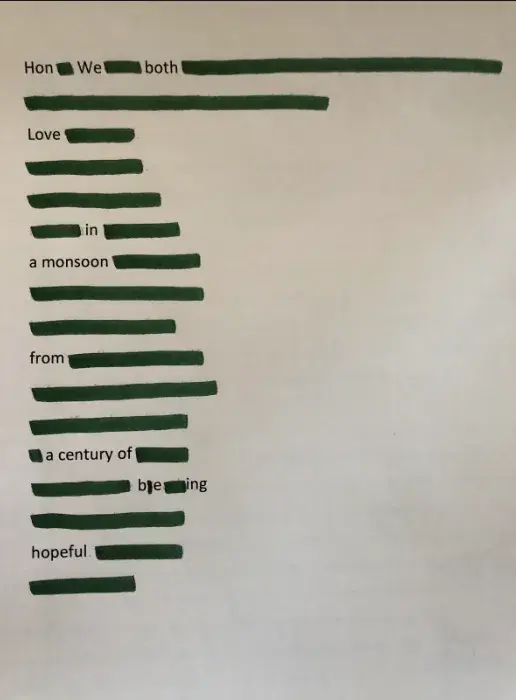
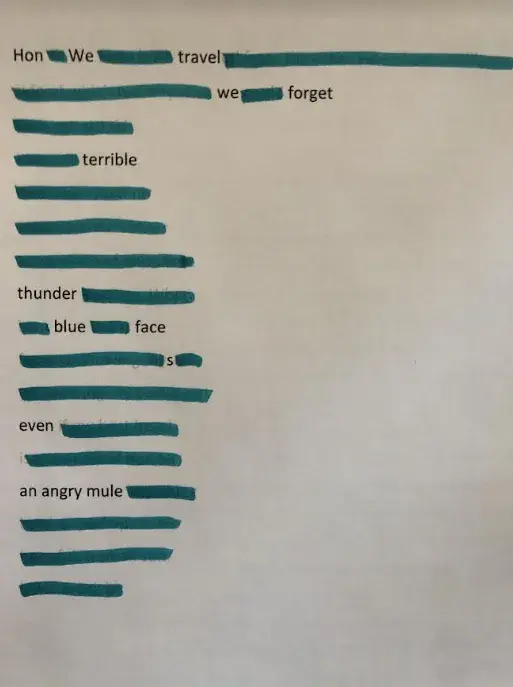
    Is this post built of hermit crab essays or hermit crab poems? (Yes is my answer.)

    HERMIT CRAB

    /ˈhərmət/ /krab/

    • An anomuran (that is, irregular in the character of the tail or abdomen) decapod crustacean of the superfamily Paguroidea that has adapted to occupy empty scavenged mollusk shells to protect its fragile exoskeleton
    • A genre-bending tool
    • The result of a writer adopting an existing form to contain new writing
  • What Came Up Overnight

    You ask what came up overnight, and all I can think of is vomit. The purging kind, where one is left drained, wrung out, hung over, Mack Truck flat, pancaked, schmeised, whammed, smashed, laid out, wrecked, racked, ruined. And somehow feeling better.

    But no. Write about vomit. How can anyone write about vomit. And why would you. After all, what is there, past the rotting fruit smell, to write about vomit.

    How janitors – now maintenance staff – in elementary schools, sprinkle the pool in the hall with pink stuff that’s supposed to smell like cherry popsicles, but that just ends up making cherry popsicles smell like vomit.

    Or how it feels in the middle of the flu, where the only thing worse than throwing up is not throwing up. Even when there’s nothing left to let go.

    Or how it feels to have someone who loves you hold your hair back, then soothe your forehead after.

    Or how it becomes competitive among the freshmen, trying to figure out how to become men in a world where there are no clear rites of passage from boyhood to manhood – not driving, not voting, not selective service, not leaving for college, not sex, not work, perhaps fatherhood unless it comes too early or too little or too late. Competitive. Like ballistic barfing. Random ralphing. Wild woofing. Sometimes thin and stringy, yellow with bile, ropy threads drooling from the mouth after. Sometimes nothing but beer, down and then up again. Sometimes it feels like the heart turning inside out, burning the throat, as undigested chunks of everyday life, wolfed down without being tasted, unchewed, return the way they came. Competitive. Varsity vomiting. And how sometimes women do it, too.

    Or how it feels in the ER, full of charcoal and self-loathing and disgust and not even being able to get this right, too few pills and not enough time.

    Or how, for a pregnant woman with a chronic illness, morning sickness brings with it the threat of throwing up one’s meds.

    Or how it feels in the ER after the injection of adrenaline or inhalation of atropine and the lungs open but so do the shakes, and you have to decide whether to let it go or hold it down.

    Or how it feels in the ER after the saline IV to rehydrate after throwing up all day and not wanting to lose the baby, and in the next bed is a fifteen-year-old, with her wrists restrained, who rattles the bedrails because she has not, quite yet, learned to purge on command.

    Or how it feels to have the dry heaves over the side of a boat in sixteen foot seas in the middle of the night, with the rudder gone and dawn and rescue still hours off, and you wonder will it ever, ever, ever be over or might it be better to drown.

  • Daughter of Two Houses

    It was a Christmas gift from my mother—a Christmas gift from a long-time lapsed Lutheran woman to her Jewish daughter.

    I grew up in a house without God. In my teens, I searched for God in the charismatic Christian campus ministries. In my twenties, I sought God in the great outdoors, in the mountains of Colorado where I grew up, went to school, and married for the first time. In my thirties, I saw God in the faces of my children.

    Then in my forties, I walked into a synagogue for the first time, for the bar mitzvah of the son of a friend, and came home to the faith of Abraham, Isaac and Jacob, Sarah, Rebecca, Rachel and Leah.

    The day of my conversion was the first time in forty years my father had set foot in a shul. My daughters beamed from the second row and my son bounced from seat to seat in the back. My mother didn’t come.

    That gift from my mother had been carefully wrapped in red paper with white snowflakes, snowmen and candy canes. No Star of Bethlehem, no wise men, no cross. No “Merry Christmas,” no Christ.  No problem.

    She means well, my mother, I have come to understand that over the years. Not merely that she means me no harm, but that she actually means me well. It has always been hard for her to show that. It has also been hard for me to see.

    The paper crinkled as I opened the gift. Fresh paper, without the softness of recycling, gently frayed at the creased edges. I never minded the reused paper. I used to think she did it because she was cheap. Now I like it because, whatever her reason, it seems to me that she walks gently on the earth as I begin to think gently of her.

    It is a sepia portrait of Julia McKee, later Julia Wingo. She is young, eighteen perhaps, but the photo is old. In the upswept hair, tight bun, high collar and closed gaze, you see nothing of the spirited young woman who was to become my great-great-grandmother.

    The photo is a reproduction, a delicately retouched copy of the fragile original my mother found among my grandmother’s things after her death ten years ago. It is framed in an oval of dark oak.

    “Who does she look like?” my mother asks.

    Dave, my oldest brother, gapes.

    “She looks like Robyn,” I say. Robyn is my niece, Dave’s daughter, twenty-two and on her way to law school in Chicago. She looks like Rachel, I think. Rachel is my daughter, eighteen and on her way to college in California.

    Dave turns to look at me. My mother looks disappointed, but it’s not the look of disapproval and disappointment I’ve seen before. Law school? How are you going to pay for that? Or: You’re pregnant … and getting married? Well, you’re too old for me to tell you what to do. Or: Religion is a crutch.

    Instead it’s a look of confusion – as if maybe the portrait isn’t of who she thinks it is.

    Dave shakes his head. “Janie,” he says to me. “She looks like you.”

    The portrait could have been me.  Same high cheekbones, same delicate face, and same sometimes opaque eyes – the ones that say I don’t feel like sharing myself with you. Same face as Robyn, as Rachel, as me … as my mother. Genetics run deep.

    I wonder how my Scots-German mother felt, giving this likeness of the women in my family, giving it to her Jewish daughter at Christmas.

    How can I help her find ease in my home, where the ketubah from my second marriage hangs on the wall, where my shelves are filled with Chanukiot, Kiddush cups and Sabbath candlesticks, where a mezuzah marks every doorway?

    She came to my wedding, the year after she gave me the portrait, but she did not come to my bat mitzvah last year. How can I tell her that my conversion was not an act of betrayal- that although my soul is Jewish my maternal bloodline is still hers?

    How can I tell her that the faith of my father and my other great-great-grandmothers called me?

    Called me home to God and my father’s people, but did not call me away from her.

    I wonder how my mother feels when she looks in the mirror and instead of seeing her seventy-four year old self, sees the Jewish face of her forty-nine year old daughter. I wonder what she thinks when she looks at me.

    The portrait now hangs in my upstairs hallway. She is really quite beautiful. Julia McKee. Robyn. Rachel. My mother. And me.

  • Island Dogs

    When I kayaked in to shore early this morning, I was thinking about men. Richard, my brother and captain of the small sailboat tied to a mooring ball in a tiny bay on the back side of one of the British Virgin Islands. And Sam.

    Having dragged the kayak over the sand, above the highwater mark, I left it between two of the open-air bars that trailed along the shoreline. The terraces were empty, the town quiet as the islanders began to come in to work as domestics and day laborers; most of the tourists, both boat people and beach people, were still asleep. The faint smell of wood smoke was beginning to drift in from somewhere above the beach. I am here in the Caribbean, instead of back home in the desert, to be with Richard, who is recovering from yet another breakup with yet another woman who doesn’t want to live on a forty-eight foot sailboat. He is forever chasing after women who break his heart.

    Sam said goodbye the night before I left for the Islands.

    Have a good time.

    Say hi to Richard.

    We’ll talk when you get back.

    Whatever happened to:

    Call me whenever you can.

    I’ll pick you up at the airport.

    Whatever happened to:

    I’ll miss you.

    Don’t go.

    So now I’m here for two weeks of warm weather, Richard’s good cooking, sailing and swimming. There will be plenty of time to help Richard sort through the short stacks of books and CD’s, separating them into his and hers, stowing the keepers in the cabinets in the galley and putting the rest
    into plastic bags. There isn’t much. She’d only been on the boat six weeks. I didn’t ask Richard how many days this one had stayed after he asked her to marry him. Her left-behind clothing will go to the charity box of some church on one of the larger islands; I might keep her red and orange hibiscus sarong and one of her sunhats if it doesn’t bother Richard too
    much. We’ll trade the books at the bars for ones Richard hasn’t read yet and the CO’s for mangoes and lettuce and fish on the islands that have no markets. At least I didn’ t have to worry about Richard calling her – no forwarding address.

    I love the nomad’s life on the boat, and the Carib is my favorite place in the world. The islands rise up out of the water like the tips of the Sangre de Cristo mountains in Northern New Mexico, rough and covered with twisted
    scrubby brush. The land itself is dry, but surrounded by the sweet shush of surf and wind. Mostly we’re sailing the smaller islands, the ones with mooring balls in the bays instead of docks, the ones with fewer people, less civilization, more quiet. Cane Garden Bay, on the back side of Tortola, is a small beach town with a grocery, a laundry and diesel.

    Santa Fe, where I live when I’m not on the boat, is a desert city in northern New Mexico, high, dry and dusty. Hot in summer, harshly cold in the winter. My house is always dusty, the kitchen counters, the bathroom floor, all covered with that light fine grit, the kind that gets on your skin and your teeth, in your shoes and your hair, and always shows up when you blow your nose.

    But Sam’s house. Sam’s house is an oasis of clean in the dustbin that is Santa Fe. Sam isn’t the only man I know who has white carpet, he’s just the only man I know whose white carpet is still white.

    Sam’s house is in one of the older neighborhoods of Santa Fe. Nothing special from the outs ide, the same dry and dusty flagstone walk up between the cactus and low ground cover, just like everyone else’s. Sam’s front door is turquoise, the same impossible turquoise as the Caribbean. The doorframe is white, just beginning to blister and peel in the tough New Mexico sun. Sam teaches eighth and ninth grade history in the public schools. He loves his job and loves his students. I don’t think he loves me.

    I brushed wet sand off my feet, laced up my running shoes and set off. The road was nearly flat for the first hundred yards or so, then hooked hard to the right and began a wicked climb, one that wouldn’t let up until it reached the spine of the island where one can look down onto the Atlantic
    Ocean on one side and the Caribbean on the other.

    Just before the bottom of the hill, an American couple walked a pair of mixed breed dogs the size of Australian shepards. The dogs looked like littermates, with the same tan and brown markings and easy gait, except that one trotted with a limp.

    I greeted and then passed the Americans, annoyed that they didn’t have their dogs on a leash. But when the dogs turned to follow me, I realized they were island dogs. They both looked well fed, or at least well enough, and one had a worn red collar, the one that didn’t limp. They must have belonged to someone.

    I slowed to a walk and was relieved, perhaps unjustly so, when they went past me, tails up and wagging, unneutered males both of them; but then, I am not really a dog person.

    They trotted by, turned to go up the road and stopped, looking back at me, waiting. The one with the limp stood on three legs, a canine Captain Ahab favoring his left front paw; they both panted in the hot tropic morning, long pink tongues hanging down like the sailboat’s telltale on a calm day.

    I went on a bit and they stayed with me, pausing frequently to look back, not impatiently, just to make sure I was still there. Fine. So today I run with dogs.

    The neighbor’s dog barked once in the still New Mexican morning air, but it was only me. I slid my key into Sam’s lock and let myself in.

    I shouldn’t have gone, I guess, but I didn’t know what else to do. I was leaving in a few hours and my favorite swimsuit was still in the drawer in Sam’s bedroom, the drawer I appropriated when I started staying over sometimes. I didn’t like hauling all that stuff around in my gym bag. Deodorant’s one thing, but after the day the only tampon I had in my bag was gummy and damp from my toothbrush, I started leaving stuff at Sam’s.

    I closed the door behind me and toed out of my shoes, leaving them on the hemp mat just inside the door. I remember the first time I saw Sam sweep under the mat- the dust patterns, mostly red, were intricate like the sand paintings of the Navajo, beautiful, spiderwebby circles and wavy lines. He lifted the mat off the smooth hickory floor and the top layer danced up into the air and hung there, twisting and turning and glittering in the desert sun. And then gone, swept off the floor and out the door, last traces damp mopped, last motes pulled out of mid-flight by the ionizer in the air conditioner, whirring quietly, constantly in the corner.

    I stepped off the rug, past the memories, and through the entryway. Sam was at school, wouldn’t be home until long after I left. I padded across the living room, toward the bedroom, my wool socks slippery on the hardwood floor. It’s cold in Santa Fe in February, and I don’t like to be cold. And I don’t like to sleep alone.

    The run up Tortola’s highest hill lasted twenty yards before the road pitched upward again and I had to slow to a walk. The road was lined with crushed aluminum beer cans, empty cardboard boxes, discarded clothing and other castoffs. One of the dogs made an easy leap to the top of the stone wall that served as both fence and token guardrail, scattering a small herd of goats on the other side. They didn’t seem interested in the scruffy little island chickens.

    Ahab heard the first one coming before I did. He stopped in the middle of the pavement, between me and the approaching car, grinding in its lowest gear down the steep road. I lifted my hand to the driver. Ahab wheeled and
    charged, barking and snapping at the back of the car. Steady Freddy watched him go by, then looked back to me again, as if to say no big deal, are you coming? Happy from the chase, tail wagging, Ahab loped to catch up.

    By the time we reached the overlook, six or seven cars and pickup trucks have been threatened and chased. A couple of drivers just ignored the small dog with the big bark and the slight limp. Most slowed down, but one sped up and swerved toward him, just missing him.

    I stood at the top of the island, looking east over the steely grey Atlantic, my back to the stark turquoise of the Caribbean bay to the west, thinking about dogs and men. I have a friend back home who says dogs are more easily housebroken than men. I don’t think that’s true. Sam keeps a cleaner house than I do, and Richard’s boat is cleaner yet.

    Sam’s bedroom is light and airy, with the big bay window beside the bed, the center glass double-hung and all double paned to keep out the summer heat and the winter cold. The window looks out over the arroyo that separates Sam and his neighbors from the houses behind them. Sam’s bonsai trees are arrayed across the dark blue tile of what used to be a window seat. The loamy smell of wet dirt lingers low in the air by the window. Sam waters -Lhe bonsai every day, even in the winter. They are spare and stark miniature trees, but they are not creatures of the desert. Not like me or like the cactus and yucca and yarrow outside the house. Under the smell of the bonsai is the sharp bite of lemon and ammonia.

    On our first month anniversary, I gave Sam a bonsai tree, a tiny pine, not much bigger than a teacup. Not a desert creature either, but I was trying to compromise. Sam never made room for it on the window seat.

    Five months later, I knelt on the white carpet to get my suit from the bottom drawer. It was so quiet in there, the windows closed up, the rhythmic click of the electric floorboard heaters, and the bonsai, just waiting. I needed my suit. Really. I did.

    I dug through my stuff, looking for my green suit, faded and smelling faintly of chlorine and salt. Toothbrush, hairbrush, assorted tampons and condoms, t-shirts, socks. I snagged my favorite bra, pushed it into my pocket. But no suit.

    The bonsai I had given Sam was no longer on top of the dresser. Neither was the framed photo of us, at the Pueblo in Taos, I had given him on our second month anniversary.

    Sam had offered to help me carry my things to my car.

    I ‘ll help you.

    I didn’t want help.

    A clean break. He didn’t look at me, but I think he actually meant it. It’ll be easier this way, if you take your things now and let me have my key back.

    I didn’t want to take my things. I didn’t want to leave Sam’s key.

    Could we talk about this?

    There’s nothing left to talk about. He held out his hand for the key, but I couldn’t. I just couldn’t. I knew I had to let him go, but not yet. Not yet.

    Okay. Sam put his hands in his pockets. Those warm, gentle hands that used to… We’ll talk when you get back.

    But I knew we wouldn’t, that he wouldn’t change his mind. He’s like that when he decides something. Like how he always sweeps the dust out from under the hemp mat by the front door. I didn’t want to talk. I wanted Sam.

    In the early morning, that last day in Santa Fe, after Sam had gone to work and I went to look for my suit, I dumped everything back into the drawer and banged it shut. My tiger striped panties caught on the side, sticking out and keeping the drawer from going all the way in. I yanked the drawer back out, shoved everything down, scraping my wrist on my hairbrush, and slammed it shut. My hairbrush used to be on top of the dresser, along with the tiny pine bonsai, and now it was shut away in the drawer. Sam must have thrown the little tree away. Or had taken it to school and given it to
    the botany teacher. Or to one of his precious students.

    I crawled to the side of the bed, Sam’s side, ignoring my CD’s and books stacked in a box by the nightstand. I tugged the covers out from under the mattress and got in. I clung to the life raft of we’ll talk when you get back. He hadn’t changed the sheets yet and the bed still smelled of him, of male sweat and goodbye sex.

    I turned my face into the pillow and inhaled the faint peppermint scent of his soap.

    Freddy, the island dog, flopped in the long morning shade of a short, wind-bent tree at the top of Tortola, panting and waiting. It was already hot, the air heavy with the scent of litter and goats. Ahab marked the stone guardrail in a couple of spots and sniffed at a small mound of trash. Sam would have loved the view; Richard would have loved someone, anyone to share it with. I stretched a bit, my knees aching from the climb, then started back down the hill, wary of the loose gravel covering the cement pavement in large patches.

    The driver of one pickup truck, going past a second time, returning from whatever early morning errand had taken him over the hill, slowed enough to ask me if they were mine. No way! I called back over Ahab’s loud barking.

    It was like being shadowed in the mall by a pair of adolescent boys, one of who is behaving badly. They’re not my dogs, I wanted to shout to the drivers who glared at me when they went by. Sometimes, when I was a sophomore in high school and Richard was nine, I used to feel that way about him. I don’ t know that kid, I’d shrug, walking six steps ahead of him at the store or the library or the movies. He’s not my brother. One time, he followed me and two of my friends all the way to the girls’ dressing room at Sweet Sixteen. He lasted twenty minutes after we’d slammed the door on him, giggling and talking about boys, before he started to whimper.

    I wanna go home.

    Big baby, one of my friends said.

    When are we gonna go home?

    Don’t you know when you’ re not wanted?

    I cracked the door open and hissed at him to be quiet, to stop making such a fuss or I’d really make him cry. He wanted to be with me so bad, he’d curled up on the floor, right in front of the door. I thought I’ d die from the embarrassment.

    But I never left him behind.

    I heard it – a small thump. The joyous barking cut short and punctuated by a canine shriek. The car never slowed down. I turned to look, but Freddy didn’t. Ahab, his limp more pronounced, loped to catch up to us, tail wagging, panting, head up as if to say it had been well worth it. But he let the next three cars go by without so much as a longing glance.

    We were nearly down off the hill, just above the turn into town, when he couldn ‘t help himself any longer. Barking and snapping, he started up again, rushing the cars going by. You ought to be on a leash, I growled. On second thought, I glared at the two dogs, both of you ought to be on leashes!

    I just wanted to run down, back to the kayak and the beach, to get away from the possibility of something really awful happening, but the hill was too steep. I’d like to think I wouldn’t have been cowardly about it, but I’d already decided that if he got badly hurt or even killed I was going to keep
    going, leave him on the road, and report it to someone, anyone, when I got back to the little town on the beach. Sam would know how to help a broken dog, where to find a vet before anything was open, how to comfort without being bitten. Even Richard would have been unafraid. I tried to pick up the pace, but not enough to risk falling on the gravel.

    Far below, the boat rocked on the in-coming tide, the mast swaying above the tightly furled sails. A haven at the end of my run . My favorite green suit hung over the railing to dry, the suit that had turned up in the bottom of my duffel once I’d gotten to the boat, the suit I hadn’t left at Sam’s.

    I saw him misjudge the distance and get hit by the truck. He wasn’t run over, just clipped on the side of the head by the bumper, a sick thud of metal to flesh and bone. He yelped, I cringed, and even his littermate turned to look.

    Ahab limped along, slowing every few steps to shake his head, pawing at his ear. Incredibly, there was no blood, no ear ripped off, no skull crushed. His spine wasn’t broken, leaving him to drag his back legs behind him, crippled like a seal on the beach. And it wasn’t the last truck he chased that day.

    The two dogs followed me all the way back in to town, to the top of the crumbling concrete steps leading down to the beach, where I’d tied up the kayak. There they turned to follow a trio of Canadians, one of the women cooing and calling them good dogs.

    The dogs trotted along with the Canadians toward where the road began to climb and the traffic grew thicker as the island came fully awake. I watched them go, thinking about men and women. And dogs. How they only chase you when you run. I wondered which truck, bumping over a furry body, would be Ahab’s last one.

    As for putting them on leashes, I know that’s a bad idea. The smart ones you don’t have to worry about. They go where they want to go, see what they want to see, generally keep you company, and stay out of traffic. The others I’m not sure can be helped.

    Maybe it runs in the family. Richard and Ahab and me. The dogs and the Canadians disappear around the first bend in the road. I turn to look for a phone to call Sam.